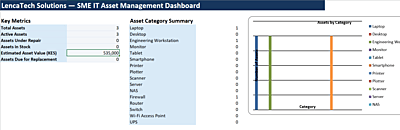
Is your business able to account for every IT asset?
For many small and medium-sized businesses, an IT asset register is often treated as a simple spreadsheet listing laptops, printers and other equipment whereas it contains the data about where you have invested and the visible returns. Download a detailed IT Asset Register Template that you can tailor to you business needs. Easily and accurately manage your asset life cycle and save on costs!
What is an IT Asset Register? In reality, it is an important IT governance and cost-control tool.
As a business grows, IT assets quickly multiply—laptops, mobile devices, servers, network equipment, software licenses, cloud subscriptions and other technology. Without a clear record of what the organization owns, who is using it, where it is located and when it needs to be replaced, significant costs and risks can remain hidden.
1. Unseen financial costs
Without an accurate asset register, businesses may purchase equipment they already own, continue paying for unused software licenses, or replace equipment prematurely.
A good register provides visibility into **asset value, warranty periods, maintenance costs, license renewals and replacement cycles**, helping management plan IT expenditure rather than react to emergencies.
2. Asset loss and accountability
When equipment is not assigned to specific employees or locations, it becomes difficult to establish accountability.
Laptops, phones, tablets and other portable equipment can be misplaced, transferred between employees or leave the organization without proper records.
An asset register creates a clear chain of accountability—from purchase and assignment to return and disposal.
3. Security and data risks
An organization cannot properly secure assets it does not know it owns.
Unknown or unmanaged devices may have outdated software, missing security controls, weak passwords or access to sensitive company information.
When an employee leaves, the organization should also know exactly which devices, accounts and software licenses need to be recovered or deactivated.
4. Poor lifecycle management
Technology has a useful life.nWithout an asset register, organizations often discover that critical equipment is obsolete only after it fails.
Tracking purchase dates, warranties, condition and expected replacement dates allows businesses to develop a planned IT replacement budget and avoid unexpected downtime.
5. Compliance and audit challenges
Organizations may need to demonstrate how company equipment and information are managed.
An asset register provides supporting evidence for internal audits, security reviews, insurance claims, procurement controls and IT governance.
6. Higher operational risk
The biggest problem is: not knowing what you have, where it is, who has it, what it costs and whether it is still secure.
That lack of visibility can lead to unnecessary expenditure, security vulnerabilities, service disruptions and poor management decisions.
An IT Asset Register Is More Than an Inventory
A well-designed IT asset register tracks and provides visibility into:
- Hardware and equipment
- Software and licenses
- Asset ownership and assignment
- Location and condition
- Warranty and maintenance
- Security status
- Replacement cycles
- Vendors and contracts
- Disposal and data destruction
For SMEs, this creates a foundation for better IT budgeting, stronger accountability, improved security and more informed technology decisions.
Is your business able to account for every IT asset? If the answer is "not sure," it may be time to establish an IT asset register. LencaTech Solutions helps SMEs organize, manage and optimize their technology environment through managed IT services, business systems and technology advisory.